Introduction
If that’s the case, you might be dealing with presbyopia, a normal age-related change to your vision. Multifocal glasses are a clever, one-size-fits-all answer, with multiple prescriptions built into a single pair. In this guide we look at how these lenses function and why modern no-line progressive lenses are the best choice for clear, seamless vision at all distances. Do you find yourself constantly changing your reading glasses for your distance glasses?
What Are Multifocal Glasses?
Single-vision lenses are designed to address one type of vision—either near or far—but multifocal lenses feature two or more prescriptions to let the wearer see clearly at a range of distances. These are for presbyopic people — those who have trouble focusing on objects up close and often develop this condition in their early to mid-40s. In practice, multifocals are prescription glasses that provide multiple prescriptions in one pair.
Searches for multiple lenses, no-line lenses, or no-line bifocals usually point to this same decision. Progressive lenses are the common no-line multifocal choice because they avoid the visible segment line found in traditional bifocals and trifocals.
This may make activities such as reading, sewing, and using a computer difficult. Multifocal glasses were developed to help with these issues and offer a simple way to see up close and far away without the need to interchange between numerous glasses. Presbyopia occurs when the eye lens hardens with age, making it harder to focus on close objects.
Multifocal lenses let you look at things like reading, driving, or viewing your phone without having to switch glasses or peeking over your glasses for activities requiring near vision. Multifocal options include bifocal, trifocal, and progressive lenses as well, and each has its own unique set of advantages to offer users, depending on their lifestyle, vision requirements, and habits. The biggest advantage to multifocal glasses is convenience.
How Do Multifocal Glasses Work?
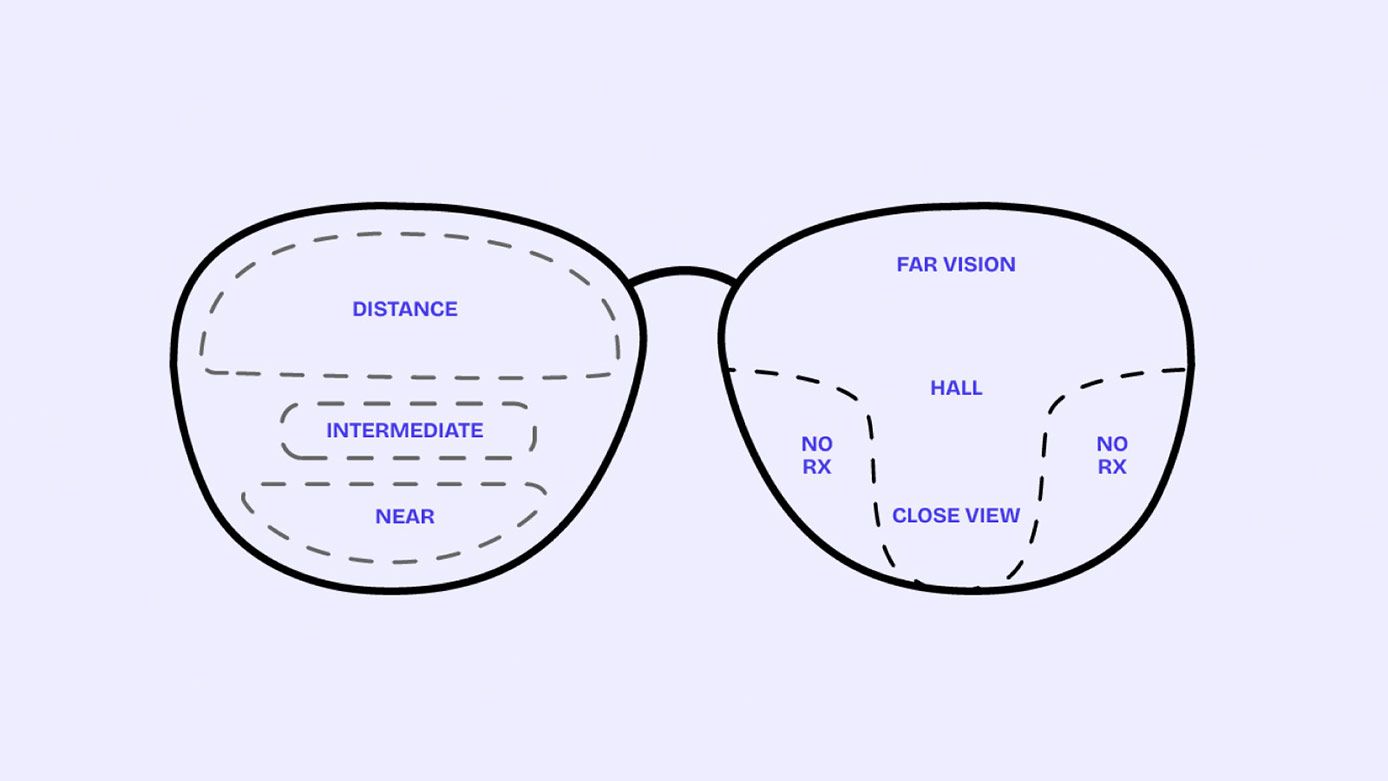
Multifocal lenses work by utilizing different parts of the lens surface for different focal lengths.
- The Top Zone: Corrects for distance (infinity).
- The Middle Zone: Gradually adds power for intermediate vision (60 cm - 1 m).
- The Bottom Zone: Provides maximum magnification for close-up tasks (30 cm - 40 cm).
Your brain naturally learns to look through the specific part of the lens needed for the task at hand—a process called neural adaptation.
Types of Multifocal Glasses
They’re all created to correct for vision at different distances, but differ in terms of lens design, comfort, and smoothness of how the wearer can integrate varying focal points. There are three main types of multifocal lenses: bifocals, trifocals, and progressives.
Comparison: Bifocals vs. Trifocals vs. Progressive Lenses
| Lens Type | Visible Lines? | Focal Zones | Transition | Best For |
|---|---|---|---|---|
| Bifocals | Yes (Distinct) | Near & Far | Abrupt | Simple reading & driving |
| Trifocals | Yes (Two lines) | Near, Middle & Far | Abrupt | Office work & desk tasks |
| Progressives | No (Seamless) | All distances | Smooth | Modern aesthetic & all-day wear |
Bifocals Glasses
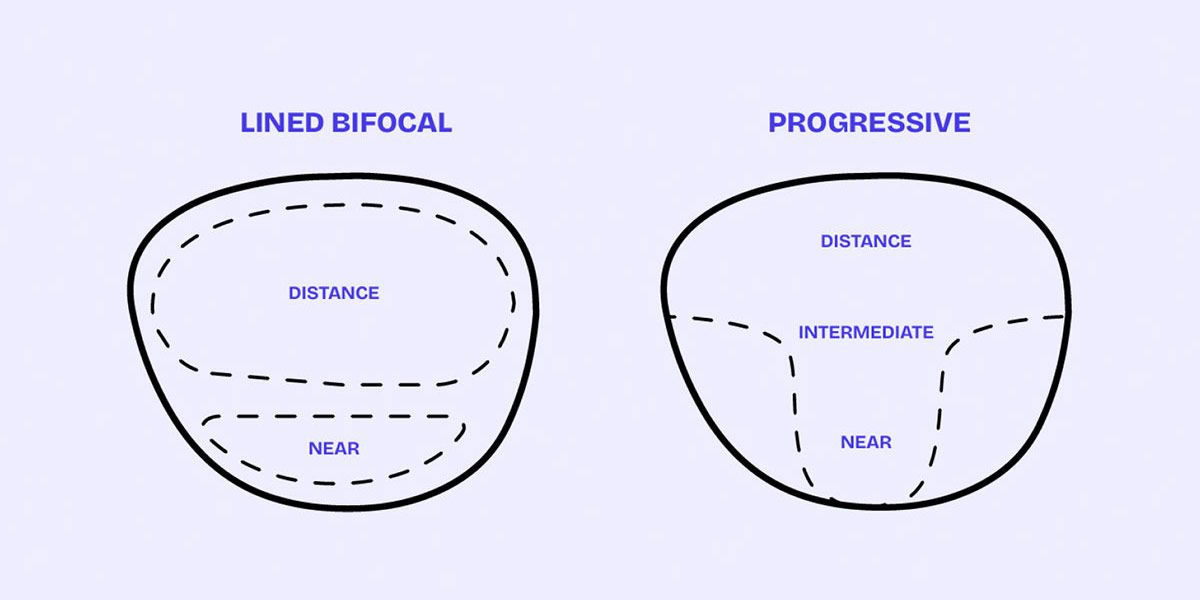
They are bitoric (having 2 zones of different curvatures). The lens is separated into two zones: the top of the lens is for distance vision, which is used for driving or watching TV, and the other half of the lens (the bottom part of the lens) is for near vision, used when engaging in near-sight activity like reading or sewing. The most noticeable feature of bifocals is the visible line that separates the two sections. This line shift from close to far is very dramatic, which can seem a bit abrupt to the wearer. Bifocal lenses are the most recognized and most regularly used form of bifocal on the earth.
In practice, bifocals are a favorite because they are simple and cheap. They are very easy to get used to and provide clear (near/far) adjustment. But the visible line may be a con for some, as it takes away the appearance from that of a traditional set of glasses. Furthermore, without a mid-range, you have to move your head to change the focal point, which is inconvenient for some activities (e.g., working on a computer screen).
Trifocals Glasses
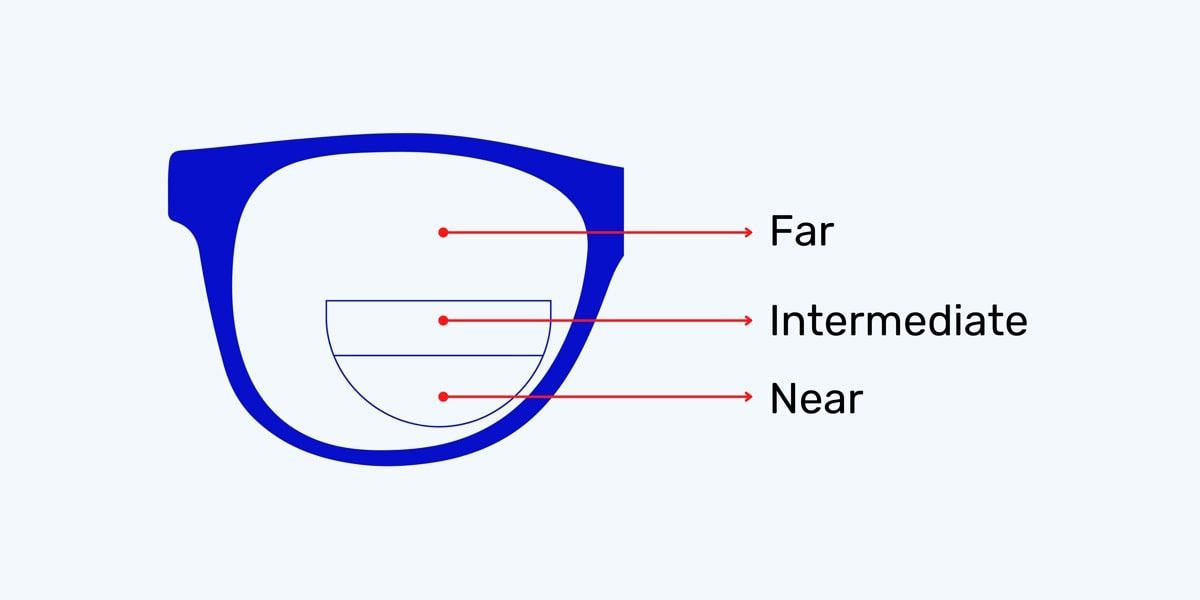
Trifocals are segmented into thirds of the lens, for distance viewing at the top, intermediate viewing (i.e., using a computer) in the middle, and close viewing (reading) at the bottom. The intermediate zone makes trifocals especially useful for situations where you have to see a range of different distances. Trifocal lenses are again like responding, but add an inset for intermediate distance vision.
Trifocals are like bifocals in that they have lines that are visible between the three areas, often creating a disruption in the way things are viewed. On top of that, the shift between these various zones may be somewhat clunky; the wearer actually has to "step" between the various focal points. For near, intermediate, and far vision, maybe while they do have their downsides, trifocals are a good choice for those who require clear vision at both close and middle-range distances in addition to far vision. Trifocals offer more versatility than bifocals, but they may be more challenging to adjust to.
Progressive Glasses
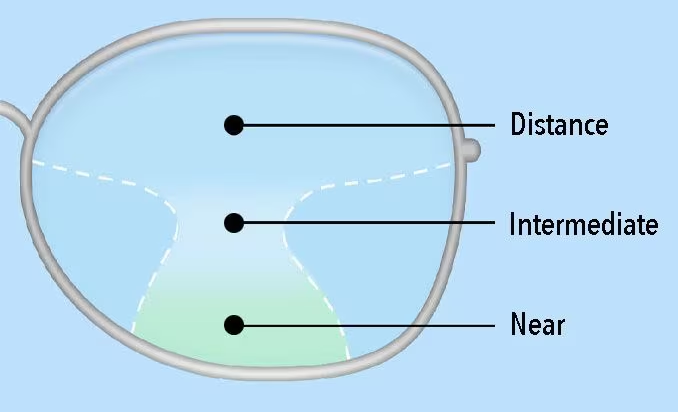
Progressive eyeglasses, unlike bifocals and trifocals, have no visible lines dividing the different viewing zones. The lens allows a gradual change from top (far vision) to bottom near vision with intermediate. This results in a more natural vision, enabling wearers to focus on objects at all distances without interruptions. Progressive lenses, unlike bifocals, are a more advanced type of multifocal lens with no visible line.
They look just like regular single vision glasses and are therefore one of our most popular lenses for anyone who wishes to keep looking modern and stylish! Progressive lenses do away with the need for frequent head movement to mediate between two or more focal points, as they themselves can provide the stepping-stone to seeing them all clearly. And even though because of that smooth transition from different focal points, progressive lenses may take some time getting used to, especially for first-time users. The adjustment period can cause them to feel dizzy or blurry or even uncomfortable, but most get used to it after a few weeks of wear. In practice, progressive lenses are mainly used for aesthetic looks.
How Do Bifocal Reading Glasses Work?
This is not the same as the ordinary type of reading glasses that cater only one level of magnification for close-up things; the reading glasses with multifocal lenses support more than one prescription that is prescribed for each person at various distances in the lens. Multifocal reading glasses is a pair of reading glasses with multi-prescription, so it may help manage presbyopia and allow you to see clearly at near, intermediate and distance in one pair of glasses.
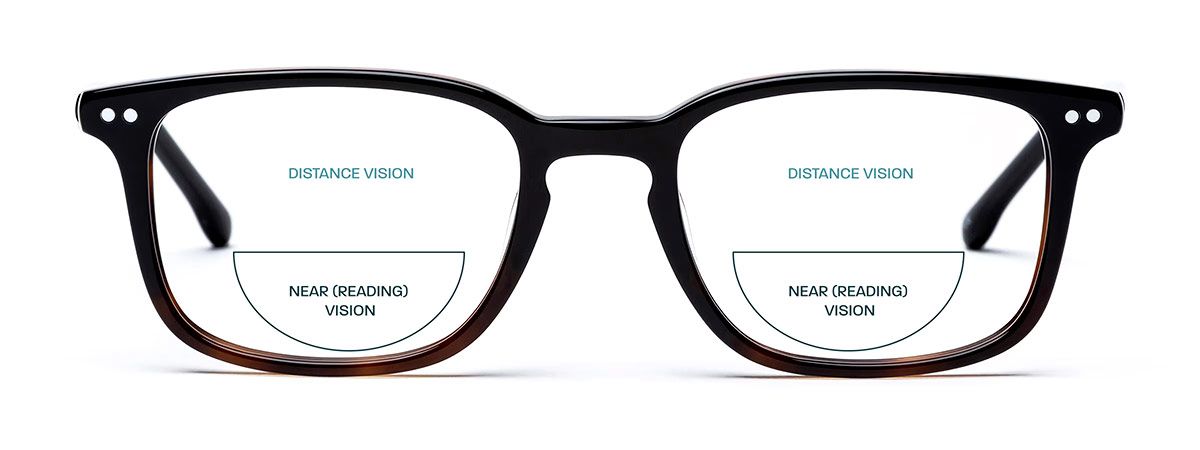
The wearer can use the bottom of the lens to read or similar to this purpose, while they can use the top of the same overcoming to see distant object. The sharp separation of the two zones may be less than ideal for some tasks - for example, computer use, where the requirements are for focus but in a range. In bifocals, the lower part of the lens focuses on close-up tasks such as reading; the upper portion is for distance.
With progressive lenses, the lower part of the lens is for reading, the middle it helps with intermediate tasks and the top is to provide distance correction. This easy change is well suited to those whose activities consist of multiple operations like a computer side assignment, reading and driving. The progressive multifocal lens, however, makes a smooth, seamless progression from close-up to middle to long distance, eliminating the notorious line and making it a far more enjoyable experience for the wearer.
They’re especially useful for those constantly switching between tasks of varying levels of attention. Progressive lenses provide an easier way for people to focus on close objects, like a book, while still maintaining clear vision at other distances, without the need to switch between glasses.
Multifocal Vs. Single-Vision Lenses
Single-vision lenses are things that help one to see one type of vision, near or far, but not both. For instance, those who are near- or far-sighted might use single-vision glasses to address “one” problem. But once a person develops presbyopia, they will probably need multifocal lenses to see clearly at all distances. It's the function the difference between single-vision and multifocal lenses.
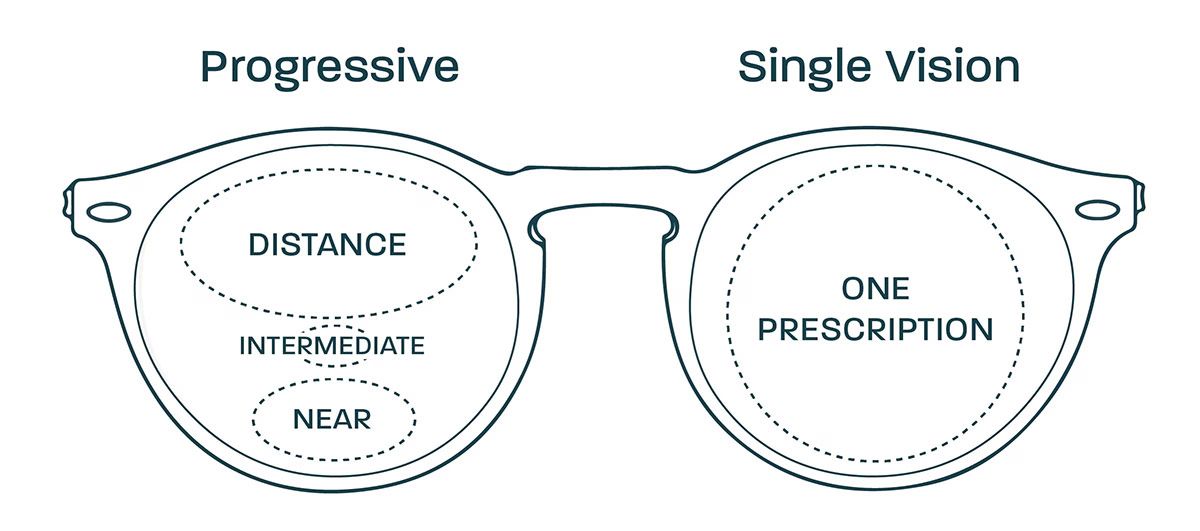
Rather than needing to pull out multiple pairs of glasses — for reading, for distance and, well, if you are like me, for the in-between — multifocal lenses let people get by with a single pair to cover all visual situations. Multifocal, however, are the type of lens that incorporate numerous focal points into one lens, so that wearers can view near, intermediate, or distant tasks with ease.
No menage is needed between near-vision lenses (a.k.a. Reading glasses) and distance-vision (normal glasses) lenses for people with presbyopia, but rather than blurring the lines between near and far vision, and the technology enables near and far vision to be blended into a single lens. Multifocal lenses are not so bad because at least it is easy to give the same solution to a presbyopic or steady medic mentation of the eyes to correct various values for distance and close viewing.
Who Needs Multifocal Glasses?
The lens inside the eyes gradually stiffens and loses its ability to focus on close objects as people age. This can pose problems with doing things such as reading, sewing or using a smartphone. Presbyopia generally starts in a person’s 40s and worsens over time. In practice, multifocal prescriptions are often used for people with presbyopia, an age-related condition in which the eyes struggle to focus on nearby objects.
For those with presbyopia and a refractive error, wearing a multi focal lenses with a single lens application, quickly correcting vision in all distances, may be even more beneficial. In practice, some people with other vision problems (such as nearsightedness, farsightedness or astigmatism) may also need multifocal lenses.
Other indications that you may need multifocal glasses include reading materials from a distance, squinting to read, and having eye strain or headaches while working on up close tasks. In practice, if you are over 40 and are having difficulty reading already, the reason could be presbyopia.
Instead of having to alternate between different pairs of glasses, you can just rely on one pair for everything, so they are especially useful for active people who like to keep their eyes on the prize! Also, if you are an eyeglass wearer who switches between glasses depending on the type of task you are performing, such as reading glasses for close-up tasks and distance glasses, for distance, multifocal lenses could be the most convenient and cost-effective solution.
FAQ
What is the difference between multifocal and progressive lenses?
Progressive lenses are the most advanced type of multifocal, offering a smooth gradient of power instead of the sharp segments found in bifocals. "Multifocal" is an umbrella term for any lens with more than one power.
How do I know if I need multifocal lenses?
If you are over 40 and find yourself holding menus at arm's length or constantly switching between reading glasses and distance glasses, you likely have presbyopia and would benefit from multifocal lenses.
Why are my multifocal glasses blurry on the sides?
In this case, this is a normal characteristic of progressive lenses called "peripheral distortion." It takes about 2–3 weeks for your brain to adapt to looking through the center of the lens for clarity.
Can I get photochromic multifocal lenses?
At the SatisVision, you can combine progressive technology with photochromic (transition) coatings, so your glasses automatically darken in the sun while providing multi-distance clarity. Yes!
Conclusion
No matter which lens you choose, you don't have to let vision problems hold you back from enjoying activities. If you are enjoying hobbies, reading, working on a computer or driving you can continue to pursue your interests with clear vision at near, far and everything in between. Which type of multifocal glasses would you choose depends on your specific motivation, style and lifestyle. Multi focus eyeglasses provide a vital tool for people with presbyopia or other vision disorders that need correction at varying distances.
With a multitude of choices, from the clarity of bifocals to the fluid and gradual transition of progressive lenses- you can find a pair of multifocal glasses that will give you a more natural and convenient view of the world. If you are not sure which is right for you, talk to an eye care professional to find the phased in pairs of multifocal glasses for you. If you are having difficulties with presbyopia or frequently changing glasses, multifocal contact lenses may be a good alternative.
No visible bifocal line.
Skip the outdated bifocals and experience SatisVision's seamless progressive lenses. Get a clear vision for driving, computer work, and reading—all in one stylish pair of glasses with no visible lines. In practice, looking for a more youthful and functional way to correct presbyopia?